Showing posts with label Chicago. Show all posts

Saturday, March 17, 2012

The Pilgrimage

Amazingly, on my recent round-the-world adventure I visited three out of my four childhood homes. The only one I missed is Beverly Shores.


The first stop on my pilgrimage was 6 Priory Walk in London. The neighborhood is as charming as ever -- still straight out of Mary Poppins.


The house needed some attention, or at least a little paint, in places.


Next I went to Chicago where 5759 was waiting for me, just as lovely and welcoming as ever. The flowers in front were just beginning to bloom. I have a profound attachment to this house.


Lastly, a quick stop at 1110 Webster Street in Palo Alto where we lived briefly one summer. My pet frogs are buried in the backyard. I remember that the light inside was beautiful.


Saturday, February 11, 2012

Poor Sad Christchurch

I've got Christchurch on my mind. We made a brief visit to the city in January. And I am thinking about it once again as I pen a short piece about Shigeru Ban's upcoming paper tube church, due to rise up from the rubble in three months time. As of December, the entire central business district (CBD) was still closed off and declared red zone. It is the equivalent of the Loop and North Michigan Avenue having been sucked out of Chicago, my point of reference for most things urban. Unfathomable. In between the hoardings and fences, one can peer inside --the once thriving commercial area now looks like a ghost town. There is still debris in situ, broken glass scattered about and buildings in various states of destruction. It looked like the EQ was just last week. Had this been Japan, I am fairly certain that things would have been tidier, if not cleaned up entirely. Evidently, even buildings that look relatively unscathed have a date with the wrecking ball due to unseen, but very hazardous, structural damage.


True, a make-shift shopping area compiled of shipping containers has sprouted just outside the CBD. On the one hand, this seems like an ingenious way to attract people back into the center of town. Though we saw lots of pedestrians milling about, the stores were understocked and kind of tawdry. We tried to find something to buy out of solidarity but it was a struggle.


I was particularly struck by the many 19th century churches outside the CBD. While awaiting repair, their steeples sit on the ground, alongside the main edifices. We witnessed this again and again. Hopefully they can all be resurrected. But bringing these historic structures up to code will be a challenge and a great expense no doubt.


The gate at the Jewish Community Center, itself in total disarray, was hauntingly off kilter. We were very relieved to learn that money is being raised for the center's rebuilding. In the meantime, weekly services take place in a member's home.

Friday, April 1, 2011

Knock, Knock, Anybody Home?


The other day, Pippi and I decided to pay a visit to Chez Barack in nearby Kenwood. Though Mr. Pres. is ensconced in another, whiter house, a guard still stands sentry in his black, armored car. We could not get past the concrete barriers without subjecting ourselves to a body search. No thank you.

Sunday, March 27, 2011

Chicago Crocuses


One advantage to being an earthquake refugee in Chicago is the crocuses. From that point of view, we could not have better timed our stay. Though temperatures have been hovering around freezing for the last few days, the crocuses are undeterred. When Pippi and I explore the neighborhood we find the little purple, yellow and white blossoms poking out of gardens everywhere.

Their colorful faces remind me of the time my mother bought me a crocus of my very own. My mother, who until very recently had a very green thumb, used to have a glass and wood shelf affixed to the wall directly below the arched windows in the room that was at that time my parents' bedroom (now an upstairs sitting room where we often congregate). This shelf was laden with potted plants that my mother tended lovingly every morning. I would often lend a hand.

One day, when I was three years old, my mother decided that I ought to have a plant of my own. So we went to the plant store on 55th Street. It was conveniently located next to Wolf's toy store which had a marvelous penny candy counter in addition to a full array of goods by Mattel, Hasbro and other lesser known toy makers. But on this day we were focused on getting me a crocus. I remember the plant store had that jungly smell and the air was quite moist. The refrigerated cases were well lit yet the shop interior was a little dark and mysterious.

It must have been just about this time of year, when crocuses were beginning to bloom. Though I knew from the start that I wanted purple flowers, I had to inspect all of the potted offerings. Finally, my decision made, we purchased a crocus plant and headed home. How proud I was of my round terra cotta pot with its little green sprigs.

For the next couple months (weeks?) I nurtured my little plant each morning, right alongside my mother, making sure it had enough to drink. I was always tempted to over water but my mother gently encouraged restraint. And in due course, the plant flowered on cue. How I loved those purple blooms!

But one day, as crocuses are wont to do, my beloved bloom shriveled up. Oh the tragedy of it all! Oh the tears! Oh the sadness! I was quite inconsolable. My mother tried to comfort me and assured me that I could get a new plant next year but I never did.

Wednesday, January 5, 2011

Frank Lloyd Wright's Favorite Color


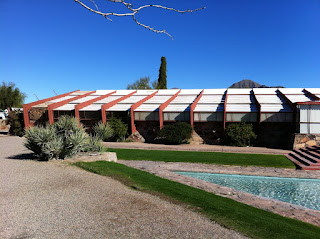
Having grown up just a stone's throw from Frank Lloyd Wright's Robie House, I am generally partial to the architect's earlier, Prairie Style works. But last week's visit to Taliesin West, Wright's home-studio at the edge of Scottsdale, Arizona, made an unexpectedly deep impression on me. I was truly awestruck by the blending of the architecture and the arid, cacti-studded landscape. The architect's later work has a strength and bold beauty of its own that, like all works of architecture, needs to be seen in person for full appreciation.


Conceived as walled terraces covered with canvas tarps, the structures were literally born of the earth. Made of local sand concrete and dessert rocks unearthed by his apprentices, these semi-outdoor rooms turned into bona fide buildings after several years of use when Wright conceded to cover them permanently and fill in the clerestory wall openings with glass. Horizontally stratified -- a central tenet of his Prairie Style works -- the buildings hover over the ground plane. While gentle steps here and there mediate floor level shifts, splayed walls and asymmetrically sloped roofs speak to the mountains rimming the property's rolling plane and express in section the triangulated geometry now very much present in plan.


We were fortunate to tour the property with Paula, a very knowledgeable docent whose Wright fascination began with a childhood visit to Taliesin West alongside her father. Paula regaled us with a steady stream of anecdotes that practically brought Wright and his entourage back to life. She explained how the students and their mentor divided the year between Wright's home-studios in Arizona and Spring Green, Wisconsin, literally pulling up stakes twice a year to travel between the two campuses -- a tradition preserved today. Like their predecessors, the students still live in tents when in Arizona but are no longer as engaged in the running of Taliesin that Wright considered essential, practical training for budding architects. The early apprentices handled food cultivation and preparation, theatrical performances and, of course, all matters pertaining to building construction or maintenance. Only by working in a kitchen could one truly acquire the skills to design one. Additionally, Paula provided plenty of entertaining lore about Ogilvanna, Wright's raven-haired, third wife and a creative presence in her own right.


Near the end of our tour, Paula highlighted Wright's love of the color red. Visible from the auditorium's red, upholstered chairs, the many red ornaments and details around the room clearly illustrated her statement. Despite her aversion to the hue, Mrs. Kaufman of Fallingwater fame was not exempt from Wright's passion for red. Blatantly disregarding his client's dislike, Wright encased each window with a red frame and then persuaded Mrs. Kaufman that they would only add to her spectacular home's wooded views. And a good thing too, since the Fallingwater fee substantially financed the purchase of the Arizona acreage for Taliesin West.