Showing posts with label Azabu Juban. Show all posts

Monday, February 7, 2011

Nico Donuts arrive in Azabu Juban


Freshly made donuts can be a memorable gustatory experience. When Abby and Eve were little, we used to buy still-warm-from-the-oven donuts every Saturday morning at the Michigan City Farmer's Market. Carted in by a baker from La Porte, they were truly out of this world. It was a very sad summer when he shuttered his shop for good.


An adorable donut maker opened recently in Azabu Juban, adding yet another option to the neighborhood's snack food shops. Located kitty-corner from Mamegen (our favorite sembei rice cracker store), Nico fronts the street with a glass display case that showcases their array cooked up at the back of the store-- not quite a scene out of Robert McCloskey's "Homer Price" (one of our all time favorite books). But close. Made from soy flour, they are deep fried and come with a variety of toppings, including white chocolate or toasted sesame seed.


Shortly after the shop opened, Pippi and I stopped to investigate. The clerk praised her product's health benefits (that's the soy flour) and informed Pippi that her donuts are equally popular with dogs. On subsequent visits, we noticed that they usually sell out for the day by 3 p.m. What is all the hubbub was about? We decided to buy a single, plain donut and find out.


Naturally, we waited for Eve, our resident donut expert, to taste test Nico's fare. My expectations were really quite low. How yummy could a donut made from soy flour possibly be? We were very pleasantly surprised. Undoubtedly, the soy flour yielded a slight grittiness. But I prefer a donut with a point of view. Texture adds authenticity. Though the flavor of the oil was evident on the exterior, the fluffy, warm interior more than compensated. Mildly sweet, the donut's light taste grew on us with each bite.


Monday, January 10, 2011

New Year's Decorations in My Neighborhood


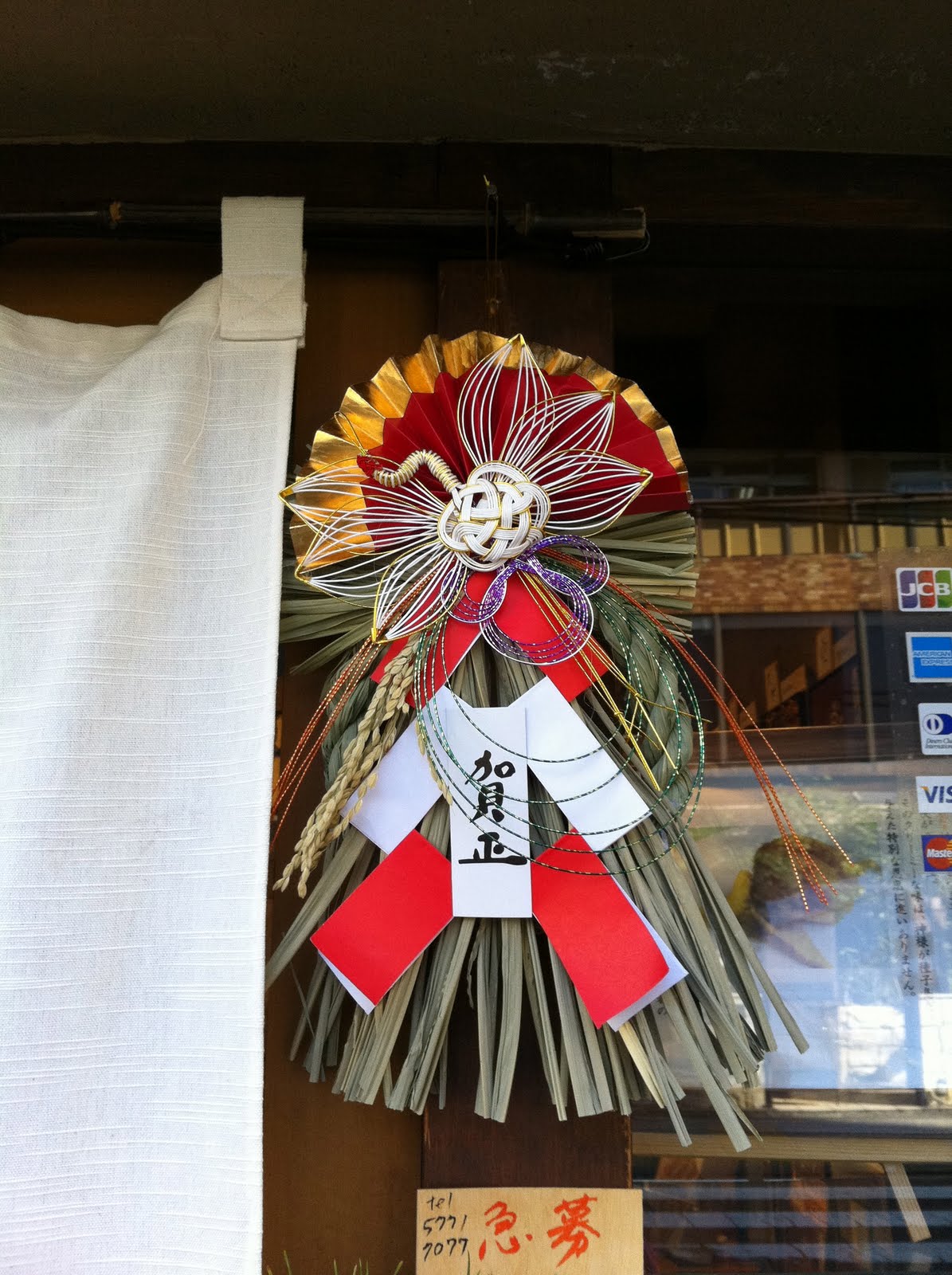
I always enjoy returning from the US after New Year's or Oshogatsu in time to see all of the special holiday decorations. Usually, by the end of the first week of January they start to disappear. When we came back from the airport, we were greeted by the Kadomatsu ornament pictured above that, along with its mate, flanked the front entrance to our building until a couple of days ago when it was quietly whisked away. It always makes me a little sad to see the spent ornaments standing by the side of the road, waiting for the garbage trucks, and marking the real end of the extended holiday period. I do not know the fate of our ornaments.

Oshogatsu is a big deal in Japan and lasts for several days when the whole country basically shuts down and many people travel either back to their hometowns or abroad. In preparation for the arrival of the new year, people in Japan have a number of customs including bonenkai parties to say good-bye to the old year, the giving of seasonal gifts (such as boxed cookies or canned fruit), and Osoji, the thorough cleaning of shops, offices and homes. Intended to start the new year off fresh, this custom may have more secular overtones today but stems from the ritual purification required prior to a visit from the Toshigami deities thought to drop in this time of year.

Once the premises are spic and span, many people adorn their home or work place with one or more decorations. There are three main types: Kadomatsu, Shimekazari and Kagamimochi. The following is a round up of adornments I spotted in and around my neighborhood.

KADOMATSU. Made of pine sprigs, bamboo, strips of zig-zag shaped, folded white paper called shide, and other decorative elements, this ornament (or pair of ornaments) stands beside the front gate or doorway to a building, residential or otherwise. Symbolizing longevity, vitality and good fortune, Kadomatsu are often free-standing but I have also seen them attached to the outer walls or gateposts.


SHIMEKAZARI. Sometimes shaped like chains or wreaths, these ornaments are attached to or above the exterior door. They usually consist of ropes of straw, dangling strips of white paper shide and other decorations that all have symbolic meaning I am sure. Apparently, the original purpose of Shimekazari was to welcome in the Toshigami deities and keep evil spirits out. Some people attach Shimekazari to the front of their car for traffic safety but I have not seen any examples this year.


KAGAMIMOCHI. Resembling a sumo wrestler in his preparatory squat, this is a two-tiered cake, the bigger layer below and the smaller one on top, made of pounded rice or mochi crowned by an orange. Recalling (sort of) the round mirrors that are a sacred objects in Shintoism (kagami = mirror, hence the name), the cakes sit on a special stand called a sampo that is placed in the household altar as an offering to the Toshigami. While some people go the whole nine yards by pounding mochi of their own, ready-made Kagamimochi is easily obtained at most supremarkets. Plastic versions also abound. The more elaborate Kagamimochi (like the giant version pictured below) are augmented with kelp, dried persimmon, lobster and other delicacies laden with symbolism. On January 11, or Kagami Biraki, kagamimochi may be opened and eaten.

Friday, November 12, 2010

Castella Tables


This pair of tables looks good enough to eat. Eve spotted them -- giant slabs of Castella cake realized in lacquered wood -- the other day when we visited Gallery Do's Design Tide spin-off exhibit. At first I thought the tables resembled Japanese puring aka custardy pudding. Nothing to get excited about in my book. But when I realized they are Castella cake my mouth began to water. Perfectly proportioned, the tables are a little darker than the real thing but the caramelized yellow color sandwiched between top and bottom layers of brown is actually more appealing than the cake's normal hue.

The tables are the product of a young designer who hails from Nagasaki. He also made the little model boat sitting on top. The boat is a bit finky and detracts from the main event. That said, I certainly appreciate his hometown pride.

There used to be an ancient Castella store in Azabu Juban. Dimly lit, the shop sold only Castella but in a wide variety of shapes and styles, most displayed in their old-fashioned, glass-fronted cases. Though Abby was quite fond of their big seller, a light spongy cake that the proprietor cut from a big slab, it never really floated my boat. Simply put, the cake lacked definition. But during a Golden Week trip to Kyushu a few years ago, I revised my opinion.

One of our main stops was Nagasaki, the birthplace of Castella. Centuries ago Portuguese missionaries introduced the cake (and a few other things, like tempura) to Japan. During our trip we encountered many Castella speciality shops. This inspired us to do a cake rating. I was really surprised by the range -- some were definitely more palatable than others. I gave my highest mark to one with a crunchy, sugary topping. If you used your imagination, it almost evoked the essence of caramel. Though I would not go out of my way to find Castella, I have a certain fondness for the confection as I look back on that wonderful holiday.

Friday, October 8, 2010

Sun-Bathing Umbrellas


Sometimes you just see something in a new light. Most of the time we do not get to see umbrellas front on like this. I took these photos in Azabu Juban after the torrential rains ended and the sunshine began. Following days of heavy use, these umbrellas were enjoying a good sun bath. They looked so pretty. And I was so happy that the rain was out of our system.

In part, the appeal of this image is purely visual -- the consistent, round shapes, the different colors and the overall, albeit accidental, composition of three across and one down. This scene also manifests certain aspects of Japanese culture. People here seem to like umbrellas and whip them out at the slightest provocation, be it a soft drizzle or, in the case of those black cloth parasols, scorching rays. Only in Japan would someone take the care to air and dry umbrellas out in the sun before returning them to their appointed place, most likely in a bin next to the front door.

Sunday, September 5, 2010

Urban Archeology in Juban


In Japan most buildings have a relatively short shelf life. But those that survive often have a long memory. Take this boarded up building on a corner in Azabu Juban. Today it is overlooked, passed without so much as a glance and probably not long for this world. About five years ago, it was briefly reborn as a tofu "soft cream" shop. But the frozen confection was vile and after a sweet summer of glory, it quietly closed and the corner parcel slipped back into oblivion.


In its heyday, the shop must have serviced the neighborhood's tonsorial needs, judging from the sad looking barber pole above and the weathered, blue-and-red awning below (I doubt the corrugated metal is original). The now shuttered, curving glass show window suggests a more dignified past. Perhaps that kind lady who is still whipping up white bread at the St. Moritz Bakery (another relic up the street) knows the full history.


Whether in Japan or the US, we just don't build elegant windows like this anymore. Construction costs, aesthetics and design abilities have changed. I suppose you could say we don't live like this anymore either. Barbers have been replaced by stylists and here in Juban everyday shops are an endangered species. I am not a hopeless nostalgic but I enjoy urban archeology.

Monday, July 19, 2010

Kirinya Curry


For years I intended to try the take-out curry from the tiny shop in Azabu Juban with the yellow awning and the signboard shaped like a giraffe, hence the name (kirin = 'giraffe' in Japanese). Inside the proprietor-chef, a shy, slender man dressed in culinary whites, takes his food preparation very seriously.


Colorful jars of spices line the white walls shielding the kitchen from view (I am sure it is spotless). But through the house-shaped opening the curry king can be seen slaving over a hot stove. The menu, complete with color photos of all the options (there are only abut 7 or 8), sits on the counter but it is also posted on the plate glass window (photos included). In Japan, you can always tell a good restaurant by its plastic food: high quality reproductions portend good eats. If the same principle applies to photos, then we were in for a treat.


Finally, I tested my hypothesis last week. I ordered two different curries, bean and vegetable, plus spare ribs for the carnivore. Both curries were very good but the bean version was exceptionally tasty -- exactly as I had imagined it would be. The mixture of chickpeas, yellow lentils, kidney beans and a few green peas was not mushy, the sauce was a little thick but not too spicy (nor too bland) and the color scheme delivered visually. Perfect with fluffy, fresh-cooked koshihikari rice. Now I am planning to become a regular. Don't you just love it when this happens?

Tuesday, May 18, 2010

The Self-Walking Dog


For years Pippi has had this lovely habit of walking her humans. When she encounters something scary, like the yakitori stand in Azabu Juban, or when she wants to go home, Pippi grabs the leash's retractable cord in her mouth and steers us in the right direction. As the thin strips of plastic fabric are not impervious to her rather impressive bite, this antic has cost us a few extra leashes. But this is a small price to pay for a behavior so charming.


Recently Pippi has taken to walking herself. Instead of simply holding the cord in her mouth, she pulls on it until she gets the entire handle between her teeth. The red plastic piece firmly in place, Pippi happily trots along beside us. The other day she walked herself all the way home from Hiroo. Fortunately we were camera ready and captured the event on film. What a dog!

Saturday, April 3, 2010

Plastic Shoes


On the way home on Friday, I noticed these shoes in a Juban shop window. Kind of a Gucci-style loafer but made of pure plastic. Aren't they ridiculous? Who would buy them? Let's hope they are just for display. Given the popularity of plastic shoes among young Japanese women I can not be sure about this. I will keep an eye out for any well-heeled gents sporting the slip-ons but that might not be until Halloween.

In all fairness, I have owned a pair or two of plastic shoes in my life. There were the purple pumps that were all the rage in New York in the 80s, the red Crocs that I held onto for about a week before deeming them too ugly for public viewing, and the black, Issey Miyake slippers I sometimes don during rainy season. They now seem destined for an early retirement since they make socks slip and generate heel blisters. Can you say "design flaw"? While I do like a good pair of high-quality flip-flops (I wonder what happened to those nice Reef brand blue ones that went to camp with Eve last summer?), this whole flip-flop boom has gotten out of hand. And if someone could come up with a suitably fashionable and durable alternative, I would stop buying leather shoes altogether.